Claudio Maria Micheli.
On the podium for over thirty-five years, a collaborator of Ennio Morricone, orchestra conductor, choir director, arranger and singing teacher.
- Conductor
- Chorus master
- Composer
- Arranger
- Guitarist
- Artistic director
- Teacher of voice, harmony and guitar
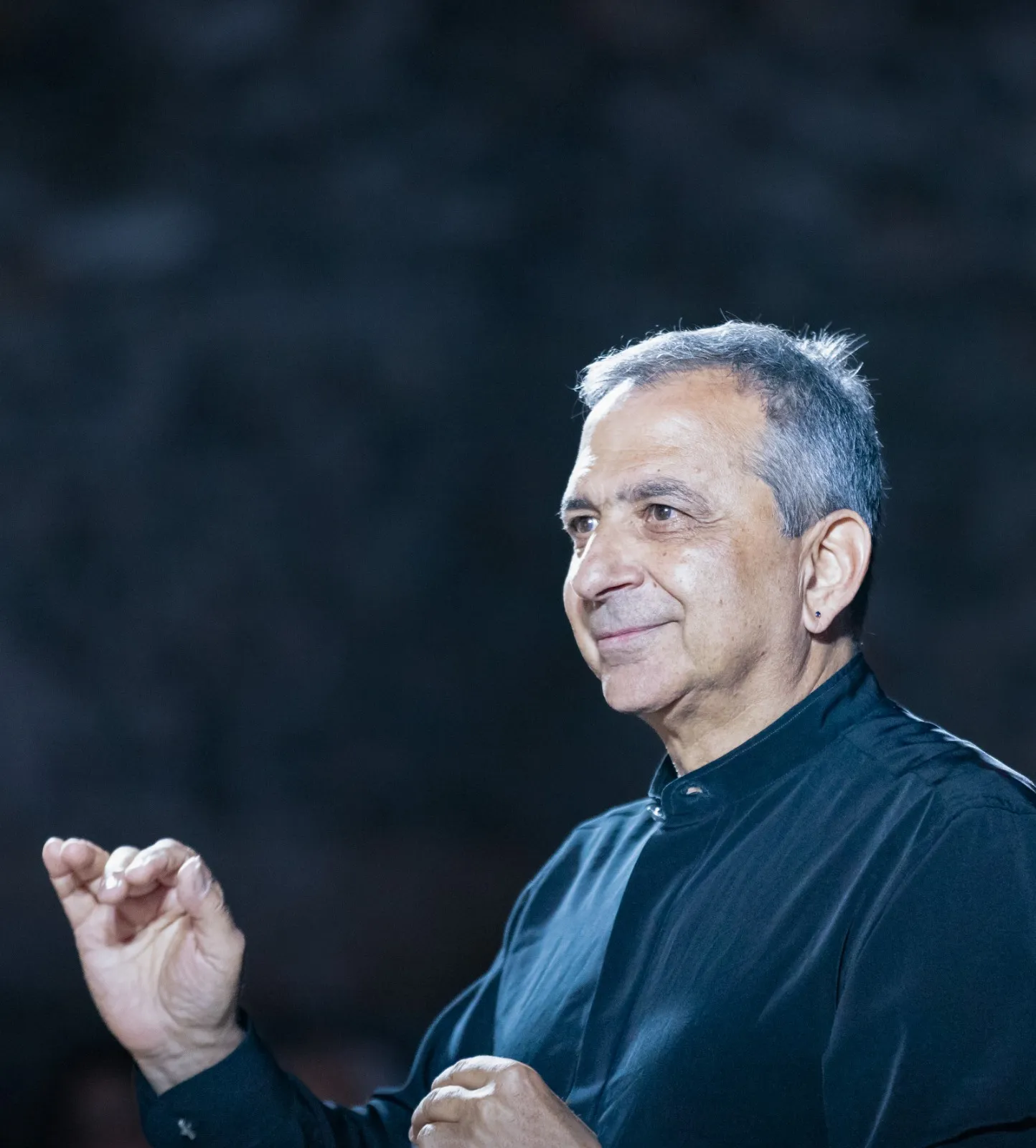
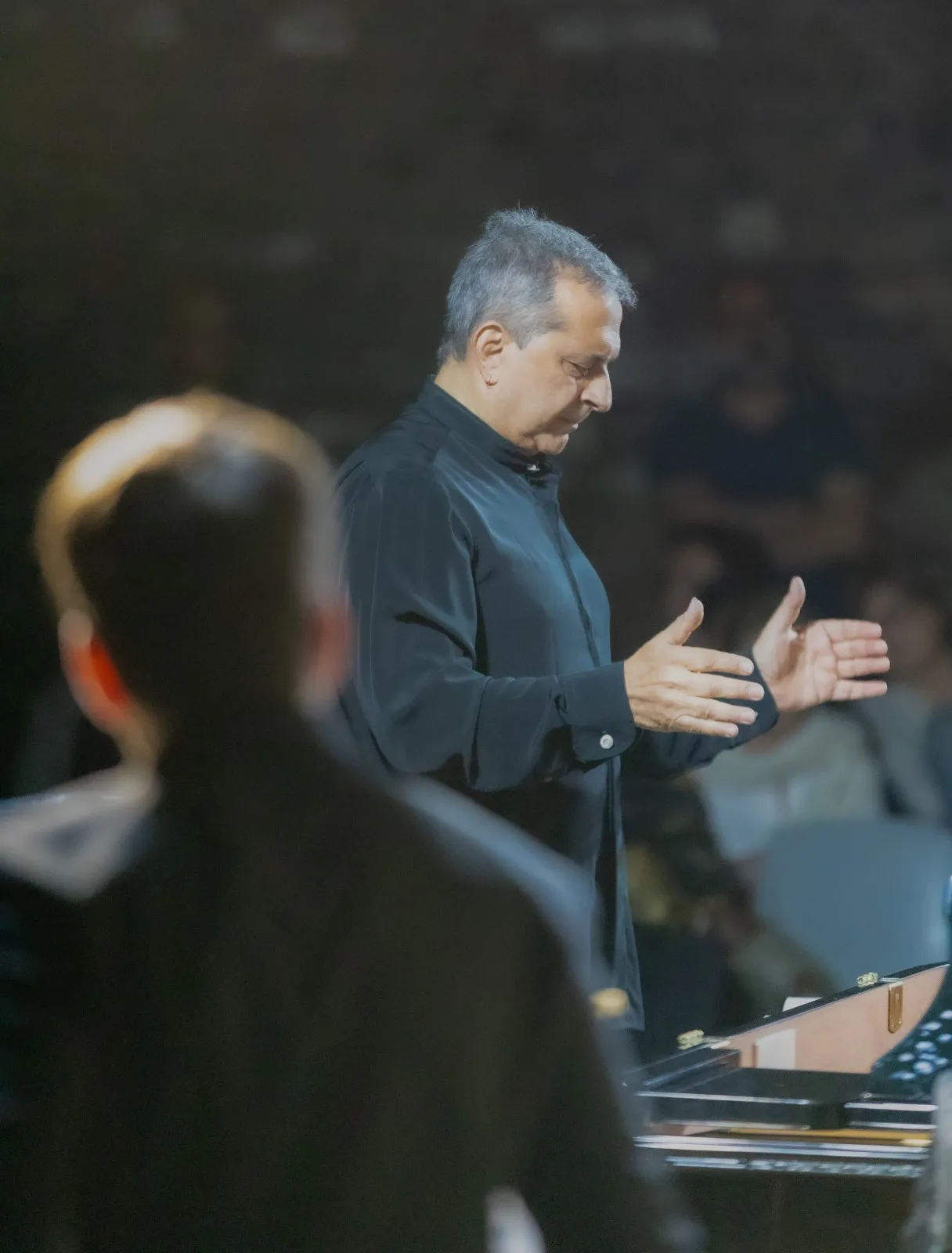
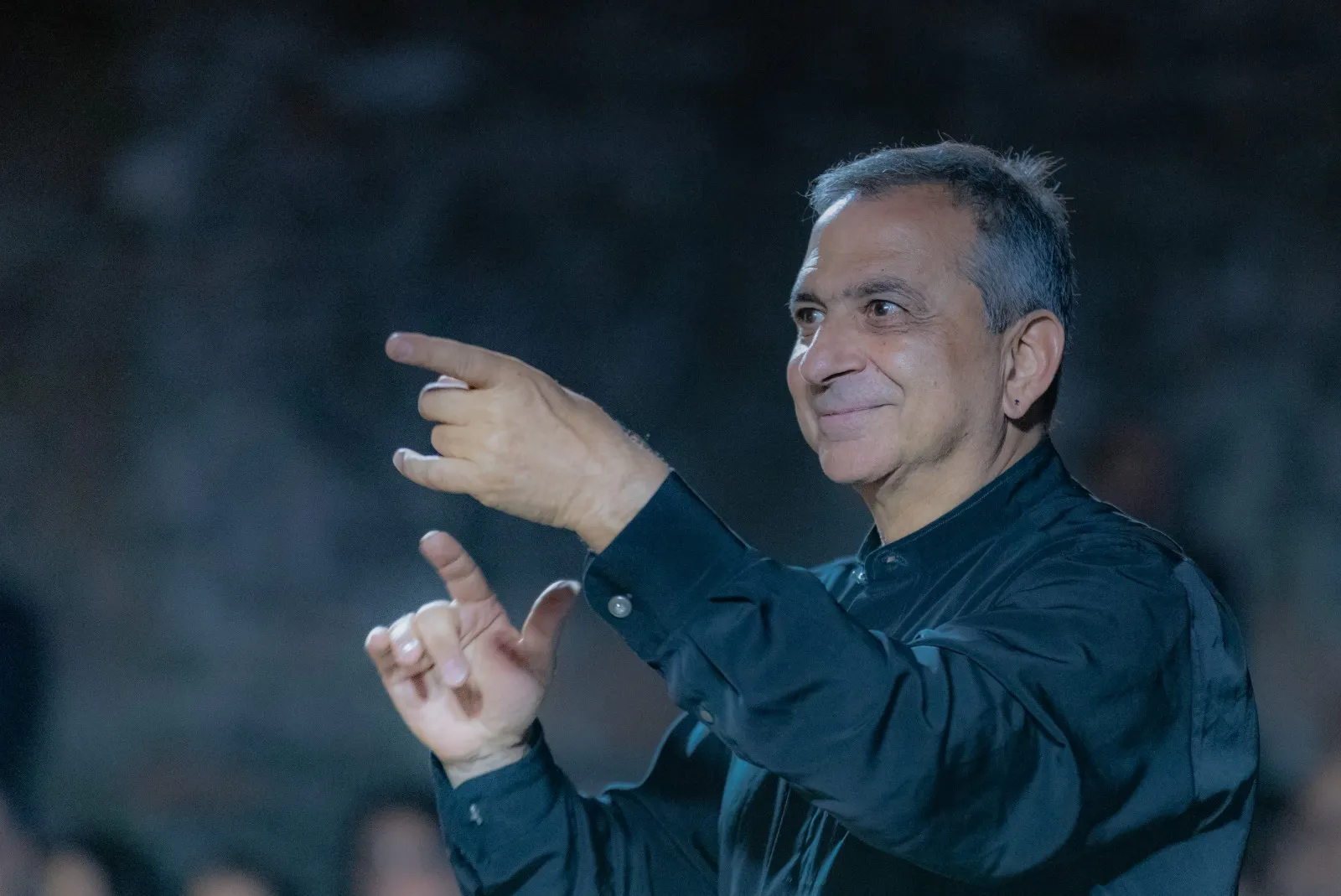
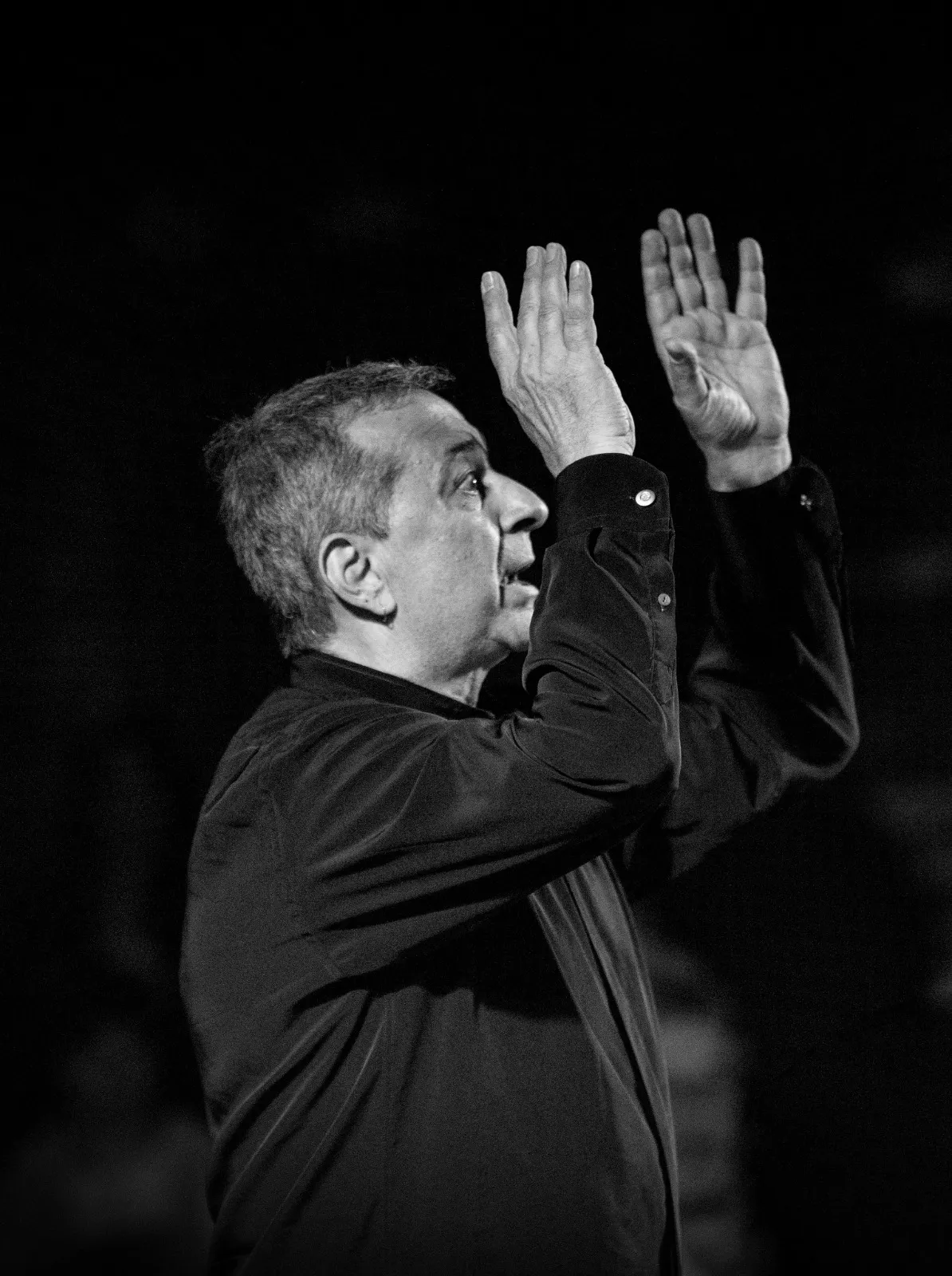
Conducts the Coro Harmonia Vocalis.
Maestro Claudio Maria Micheli, who has led the Coro Harmonia Vocalis since its founding in 2019, is the architect of its growth.
For over thirty years he has conducted the Coro Ruggero Giovannelli, which together with Harmonia Vocalis now forms a single choral group of about eighty voices, with a shared concert repertoire.
At the head of the ensemble, supported by the symphony orchestras he brings into his events, he covers almost the entire sacred and secular repertoire, from the Baroque to the twentieth century, up to the music of Ennio Morricone, with whom he collaborated in the early 2000s.
A chorus master and singing teacher, he asks his singers for commitment, dedication and attendance at rehearsals: quality of singing and colour of sound are, for him, essential to performances that must always be engaging, never ordinary.
Early years
Born into an artistic family in Rome on 1 October 1957, he grew up in the world of the stage: his grandfather Luigi was stage manager and director of the chorus and extras at the Teatro dell’Opera di Roma, his grandmother Elena head seamstress at the same theatre and in film, his father Dario set and interior designer for films by Bernardo Bertolucci, Sergio Leone, Dario Argento, Alessandro Blasetti and Vittorio De Sica, as well as a director of opera and theatre; his uncle Elio was a set and costume designer.
At 6 he acted in the film Il figlio di Coriolano, and at 7 he played in Alessandro Blasetti’s Liolà with Ugo Tognazzi. In the same years he sang as a boy chorister with the Choir of the Teatro dell’Opera di Roma during the summer seasons at the Baths of Caracalla (Carmen, La bohème, Turandot), showing an early passion for theatre and music: he soon took up the guitar, performing in public by the age of 13.
After his classical high-school diploma at the Liceo Mancinelli in Velletri, he followed his father to theatres all over Italy, working as stagehand, props man and assistant electrician: alongside impresarios and artistic directors he learned how a show is run, solved and staged.
At 17 his passion and technique on the guitar led him to work full-time as a session guitarist at RCA in Rome, with the label’s leading arrangers, on tour and in the studio with Lucio Dalla, Claudio Villa, Rino Gaetano, Adriano Pappalardo, Mimmo Locasciulli, Gabriella Ferri, I Vianella, Gilda Giuliani and many others.
Training
As a young man he studied jazz guitar with Massimo Ruocco and harmony with Bruno Tommaso at the Saint Louis Jazz Club in Rome.
He studied classical guitar with Maestro Bruno Battisti D’Amario and graduated from the Conservatorio di Santa Cecilia in Rome, with Maestro Mario Gangi chairing the examining board. He went on to study with Manuel Barrueco, José Tomás and Leo Brouwer, performing widely in Italy and abroad; in 1985 and 1986 he received the certificates of the International Advanced Course in classical guitar from the Ars Academy in Rome.
His lasting passion for opera then led him to study Composition at the Conservatorio Licinio Refice in Frosinone with Maestro Luciano Pelosi and, later, Conducting. He refined his opera repertoire with Maestro Danilo Belardinelli and then with Maestro Nicola Samale.
On the podium
He made his debut in 1991 with a series of concerts with the tenor Giuseppe Di Stefano in Germany’s leading theatres: Bonn, Stuttgart, Berlin, Frankfurt, Wiesbaden, Lübeck, Hanover, Munich, Nuremberg, Düsseldorf, Cologne, Hamburg.
Since then he has conducted more than 900 operas and opera and symphony concerts, at major events in Italy and in Albania, Austria, Belgium, Bulgaria, South Korea, France, Germany, Slovenia, Spain, Switzerland, Ukraine and Venezuela. The artists he has conducted include Ghena Dimitrova, José Carreras, Nunzio Todisco, Lando Bartolini, Nicola Martinucci, Giuseppe Taddei, José Sempere, Luca Canonici, Tiziana Fabbricini, Gianfranco Cecchele, Marco Berti and Piero Giuliacci.
As a ballet conductor he has worked with Carla Fracci, Beppe Menegatti, Fredy Franzutti (Adam’s La fille du Danube at the Teatro dell’Opera di Roma), Raffaele Paganini (Prokofiev’s Romeo and Juliet) and Mario Bigonzetti (Adam’s Giselle). He has worked with directors and designers such as Lamberto Puggelli, Franco Zeffirelli (Aida in the 1963 La Scala staging, at the Seoul Opera), Paolo Bosisio, Gianni Quaranta, Enrico Stinchelli, Dario Micheli, Franco Vacchi, Stefano Piacenti, Beppe De Tomasi, Silvio Giordani, Renato Bonajuto and Guido Zamara.
In Roberto Benigni’s film Life Is Beautiful he plays the conductor, leading the Barcarolle from Offenbach’s The Tales of Hoffmann at the Teatro Petrarca in Arezzo.
Alongside opera, his speciality, he devotes himself with equal success to the great symphonic repertoire, as principal and guest conductor of many institutions.
Awards and appointments
In 1992 he received the “Ferruccio Tagliavini” Gold Plaque as best young emerging conductor, followed by the “Mario Del Monaco” Gold Plaque and other career awards. In 2004 the city of Velletri entered him in its Golden Roll of Merit for his work in the area and his artistic career.
He has been principal conductor and artistic and organisational consultant of the Farnese Ballet Festival in Piacenza, the Festival Dannunziano at the Teatro del Vittoriale in Gardone Riviera, the Vigevano Ballet Festival, “Settembre in musica” at the Teatro Brancaccio and Teatro Manzoni in Rome, Lario Lirica in Cernobbio and the Arlecchino d’Oro in Mantua, where on the 2004 opening night he conducted dances by Verdi and Prokofiev inspired by Shakespeare, with Giorgio Albertazzi.
In Italy he has conducted the Orchestra of the Teatro dell’Opera di Roma, the Como Philharmonic, the orchestras of the Teatro Verdi in Pisa and the Teatro Verdi in Piacenza and the Piedmont Youth Symphony Orchestra, of which he is guest conductor; abroad, the theatre orchestras of Palma de Mallorca and Las Palmas and the opera orchestras of Seoul, Maribor, Kharkiv, Dnipro, Sofia and Tirana.
In Rome he has conducted at the Teatro dell’Opera, the Auditorium Conciliazione, the Auditorium Parco della Musica, the Teatro Nazionale, the Teatro Brancaccio, the Teatro Greco, the Teatro Argentina and the Teatro Manzoni, where he conducted Prokofiev’s Romeo and Juliet with the étoile Raffaele Paganini. Other Italian cities where he has conducted concerts and operas include Alessandria, Arezzo, Benevento, Carrara, Catania, Chieti, Como, Crotone, Foggia, Frosinone, Grosseto, Isernia, Ivrea, Latina, Lecce, Lecco, Livorno, Lodi, Lucca, Mantua, Marsala, Messina, Milan, Monza, Naples, Novara, Padua, Palermo, Pescara, Piacenza, Pistoia, Potenza, Ragusa, Rieti, Rovigo, Taranto, Turin, Trapani, Udine, Varese, Vercelli, Vicenza and Viterbo.
Choirs, competitions and teaching
From 2000 to 2003 he was chorus master for Ennio Morricone, at the Arena di Verona (recorded on DVD), the Palais des Congrès in Paris, the Campi Flegrei in Naples, the Perdonanza in L’Aquila and the Vittoriano in Rome.
He has worked as chorus master and conductor with the Corale Luigi Antonio Sabbatini of Albano, the Coro Polifonico of Ciampino, the choir of the Scuola di Musica Popolare di Testaccio, the Coro CAI “Città di Novara”, the Coro “Città di Como”, the Coro Lirico della Toscana, the Coro Lirico “Città di Roma” and the opera choirs of Maribor, Dnipro and Kharkiv.
He was president of the “Città di Colleferro” International Competition for Opera Singers and since 1995 has been resident conductor and juror of the “Mattia Battistini” International Singing Competition. He has conducted the finalists’ concerts of the 23rd “Città di Senigallia” International Piano Competition, the 1995 “Maria Caniglia” competition and the “Città di Roma” International Competition for Opera Singers (1996, 1997, 1998 and 2000). In 2022 he conducted the Opera International Competition and sat on the jury of the “Ionel Perlea” International Conducting Competition in Romania.
In the Province of Rome’s three-year MusicOrienta project (2006-2008) he led the Roma Electric Orchestra, made up of musicians aged 16 to 23, as conductor and supervisor of the masterclasses. In 2009 he sat on the commission of ANCI’s national competition for the social inclusion of young people through youth orchestras and bands; in 2013, for AIG (the Italian Youth Hostels association), he organised 20 masterclasses in Bologna and Perugia for young musicians with, among others, Tullio De Piscopo, Vittorio Nocenzi, Angelo Branduardi, Rossana Casale and Christian Meyer.
Since 2016 he has taught the advanced conducting courses of the Civica Scuola delle Arti - International Academy of Music in Rome, and he teaches conducting at the Summer College of the Federico Cesi Festival in Umbria.
Research, composition and choral music
Since 1990 he has conducted the Coro Ruggero Giovannelli of Velletri, with which he has given about two hundred and fifty concerts, and with the Ensemble “Ruggero Giovannelli” he performs the madrigals of the Velletri-born composer, a pupil of Giovanni Pierluigi da Palestrina.
In 2000 he brought back to light works by the Velletri composer and Maestro Rodolfo Leoni, performing them at the Teatro Aurora in Velletri; the research also led to Daniela Neri’s book La luce dell’anima. In 2012 he was artistic consultant for the reopening season of the Teatro Artemisio “Gian Maria Volonté” in Velletri, which he inaugurated conducting Orff’s Carmina Burana; in 2014, for the bimillennium of the death of Augustus, he composed and staged there the progressive opera Carmen Saeculare. From 2016 to 2021 he was artistic director of the Fondazione Arte e Cultura of the City of Velletri, the Casa delle Culture e della Musica and the Teatro Artemisio.
In 2019 he founded the Coro Harmonia Vocalis in Rome, which he leads, and he is artistic director of the Associazione Culturale Musicale Roma Musicanta, of which the choir is the artistic expression. With the choir he works with organisations that produce musical and cultural events featuring the great works of the choral repertoire.
Repertoire
- Vincenzo Bellini
- I puritani, La sonnambula, Norma
- Georges Bizet
- Carmen
- Gaetano Donizetti
- Don Pasquale, L'elisir d'amore, Lucia di Lammermoor
- Umberto Giordano
- Andrea Chénier, Fedora, La cena delle beffe, Siberia
- Charles Gounod
- Faust
- Ruggero Leoncavallo
- Pagliacci
- Pietro Mascagni
- Cavalleria rusticana, Iris
- Wolfgang Amadeus Mozart
- Così fan tutte, Don Giovanni, Le nozze di Figaro
- Giacomo Puccini
- La bohème, La fanciulla del West, Madama Butterfly, Manon Lescaut, Tosca, Il trittico (Il tabarro, Suor Angelica, Gianni Schicchi), Turandot
- Gioachino Rossini
- Il barbiere di Siviglia, La gazza ladra, L'occasione fa il ladro, Mosè
- Giuseppe Verdi
- Aida, Attila, Don Carlos, Il trovatore, La forza del destino, La traviata, Macbeth, Nabucco, Otello, Rigoletto, Un ballo in maschera
Adam, Albinoni, Bach, Beethoven, Bizet, Brahms, Britten, Charpentier, Chopin, Corelli, Fauré, Gershwin, Grieg, Handel, Haydn, Liszt, Marcello, Mendelssohn, Morricone, Mozart, Mussorgsky, Offenbach, Orff, Poulenc, Prokofiev, Puccini, Ravel, Rossini, Saint-Saëns, Schubert, Schumann, Tchaikovsky, Verdi, Vivaldi
- Adolphe-Charles Adam
- Giselle, La fille du Danube
- Georges Bizet
- Carmen Suite
- Frédéric Chopin
- Les Sylphides (Chopiniana)
- Sergei Prokofiev
- Romeo and Juliet
- Maurice Ravel
- Boléro
- Igor Stravinsky
- Pulcinella
- Pyotr Ilyich Tchaikovsky
- The Nutcracker, Swan Lake, The Sleeping Beauty
Reviews
Excerpts from reviews of his concerts and operas, collected in his CV.
The video loads from YouTube (without cookies) only when clicked.
The star of the evening was conductor Claudio Micheli, who gave the opera his own pace of clear, vigorous tension, where strong contrasts of light and shade sit alongside warm, communicative lyrical openings.
The success rested on the podium. Claudio Micheli's conducting was fluid and rigorous, Puccinian and pragmatic, creating a perfect osmosis. A confidence that breeds confidence. Batons like this are becoming ever rarer.
Choir and orchestra were in splendid form, set alight by Claudio Micheli, a conductor with clear ideas and a sure, compelling gesture, ranging from searing whirlwinds and fierce accents to elegiac tones.
From the very first bars, entrusted to the cellos, Maestro Claudio Micheli, full of impetus and at the same time deeply focused, created an atmosphere of intense expressiveness and drama.
Maestro Claudio Micheli led the performers with genuine flair and passion, drawing heartfelt, precisely shaped phrasing from them.
The real success of the evening is due to the young conductor Claudio Micheli, who showed a strong personality, great charisma and a precise gesture, in both the lyricism and the drama of Verdi's masterpiece.
The first merit of the evening goes to Maestro Micheli, who brought the orchestra into immediate harmony with the soloists' ideas, giving it a convincing flexibility: the work of a musical mind as experienced as it is lucid.
Maestro Claudio Micheli, towering above everything and everyone, made the fortune of this performance. Some artistic directors and opera-house superintendents would do well to come and watch Claudio Micheli.
Claudio Micheli's lucid conducting was perfect and authoritative, without the slightest blemish, creating a three-way understanding between score, orchestra and stage.
Claudio Micheli truly worked miracles with the young, quick and tight Nova Amadeus orchestra, finding at once the "communicative" formula to blend and ignite players and singers.
The exceptional protagonist was conductor Claudio Micheli, who from the very first bars impressed with his decisiveness, clear intent and the steady hand with which he held together an orchestra he had met the day before.
Micheli's reading is analytical, always seeking some new opening into the world of melodrama, bringing out every glimmer of exciting truth. His commanding yet always buoyant gesture is set on obtaining from everyone not only great precision but the utmost expressive relevance.
The true "deus ex machina" of the performance was conductor Claudio Micheli. Strong-willed and commanding, he drove the supple Lario Lirica orchestra with an inner, vital energy.
A passionate and compelling reading, rigorous and at times magical, as the spell passed seamlessly from the stage to the music in an almost hypnotic continuum.